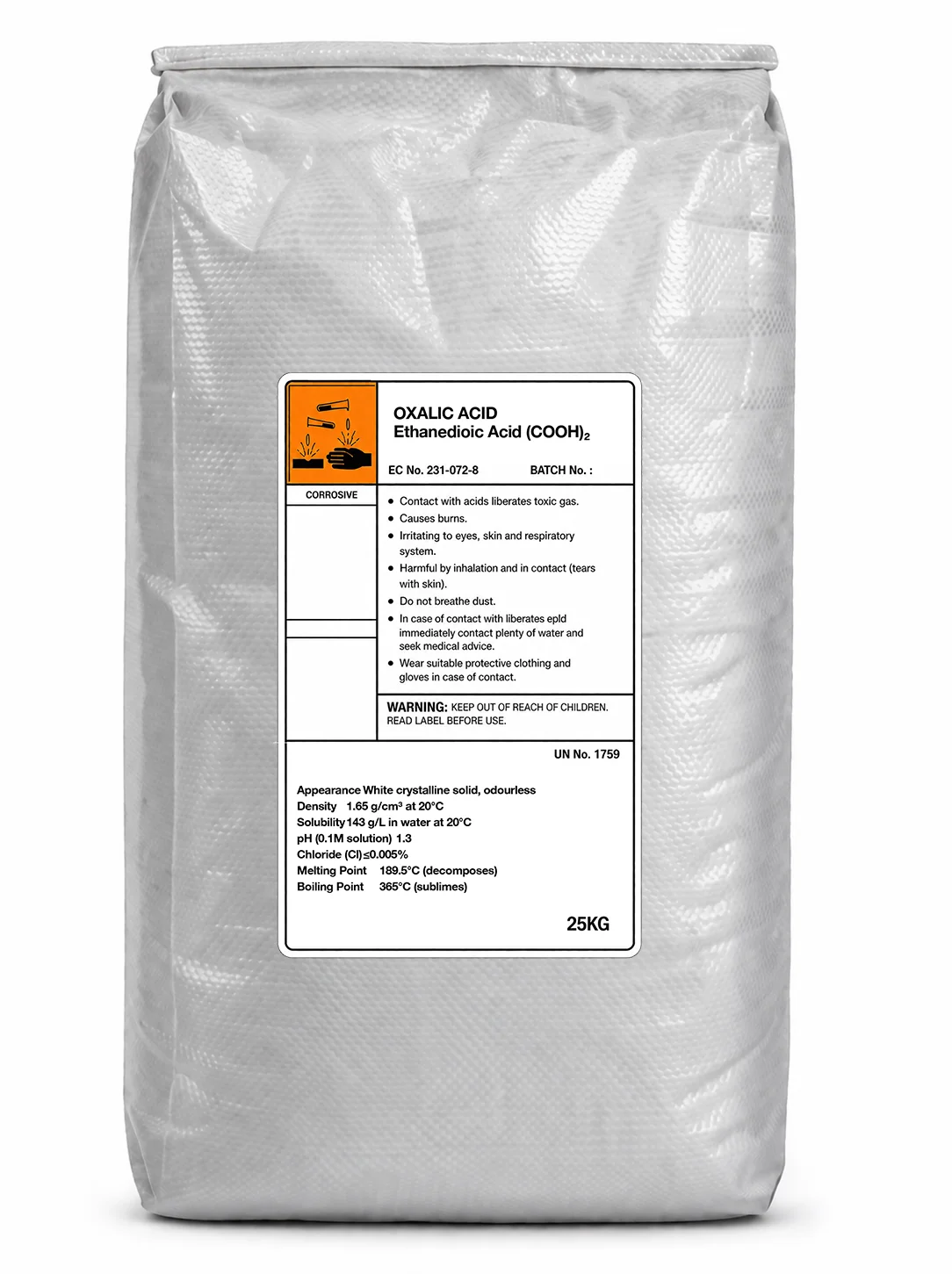
Oxalic Acid (Ethanedioic Acid) 25Kg
Oxalic Acid for Groundwater Treatment
Product Overview
Oxalic acid is a naturally occurring organic acid that serves a specialized and valuable role in raw groundwater treatment. Unlike traditional alkalis used for pH correction, oxalic acid functions as both a mild acidifying agent and a powerful reducing agent, making it uniquely effective for specific groundwater challenges—particularly the removal of iron, manganese, and hardness scale.
How It Works
When introduced to raw groundwater, oxalic acid dissociates to release hydrogen ions, gently lowering the pH of high-alkalinity waters. This acidification serves two critical purposes.
- First, it shifts the carbonate equilibrium, converting bicarbonate and carbonate ions into carbon dioxide, which reduces scaling potential and assists in the breakdown of calcium-based deposits.
- Second, and more distinctively, oxalic acid acts as a reducing agent—donating electrons to oxidised metals.
This reduces ferric iron (Fe³⁺) to ferrous iron (Fe²⁺) and converts manganese dioxide to soluble manganese, allowing these metals to remain dissolved and be removed through subsequent ion exchange or filtration processes.
Role in Treatment Enhancement
Oxalic acid's reducing properties offer advantages that conventional pH adjusters cannot provide. When used ahead of oxidation steps, it conditions the water by converting problematic oxidised metal species into forms that are more responsive to downstream treatment. It also sequesters metal ions through chelation, preventing them from precipitating prematurely and fouling membranes or filter media.
Additionally, oxalic acid is highly effective at dissolving iron and manganese oxide deposits that accumulate in wells, pipelines, and treatment equipment, acting as a cleaning agent that restores hydraulic capacity and improves overall system efficiency.
Key Features and Benefits
Oxalic acid provides precise pH reduction for high-alkalinity groundwaters, bringing the pH down into the optimal range for subsequent coagulation or disinfection processes. Its strong reducing capability enhances the removal of iron and manganese by keeping these metals in solution until they reach dedicated removal units. The acid also prevents scaling by breaking down calcium carbonate and other mineral deposits, protecting downstream equipment from fouling and extending the service life of membranes, valves, and piping. Unlike strong mineral acids, oxalic acid offers a safer, more controlled acidification option with less risk of over-dosing and excessive pH crashes. Its chelating properties further aid in dispersing colloidal particles, improving the clarity of treated water.
Typical Applications and Dosing
- For iron and manganese removal, typical doses range from 5 to 30 milligrams per litre, depending on the concentration of oxidised metals present.
- For scale control and pH reduction, doses generally fall between 10 and 50 milligrams per litre, adjusted to achieve a target pH of 6.0 to 7.0.
- When used as a well rehabilitation or equipment cleaning agent, higher doses of 100 to 500 milligrams per litre may be applied in batch treatments, followed by thorough flushing.
- For groundwater with high alkalinity, oxalic acid is often dosed upstream of aeration or chemical oxidation to precondition the water and improve overall treatment efficiency.
Operating Considerations
- The effectiveness of oxalic acid depends heavily on raw water composition, including alkalinity, hardness, and the existing oxidation state of metals present.
- Temperature influences both dissolution rate and reaction kinetics, with colder waters requiring slightly longer contact times.
- Because oxalic acid removes calcium by forming insoluble calcium oxalate precipitates, care must be taken to avoid excessive dosing that could create new scale issues.
- It is essential to monitor pH continuously and adjust dosing rates incrementally to achieve the desired acidification without destabilising the treatment process.
- Oxalic acid should be fed using corrosion-resistant equipment, as it is moderately corrosive to mild steel.
- Compatibility with other treatment chemicals should be verified, particularly with strong oxidants, which may react unpredictably with the acid's reducing properties.
- When using oxalic acid alongside chlorine or permanganate, proper separation of feed points is recommended to avoid premature consumption of either chemical.
Oxalic Acid for removing Iron Stains on Walls
Diluted oxalic acid is highly effective for removing iron staining from walls because it works as a reducing agent that chemically converts insoluble ferric iron (rust) into soluble ferrous iron, which can then be easily rinsed away with water.
To use it safely, prepare a solution of approximately one part oxalic acid crystals to ten parts warm water (around 10% concentration), though lighter stains may respond to a weaker 3–5% mixture. Apply the solution sparingly to the stained masonry, brick, or concrete surfaces using a brush, sponge, or sprayer, allowing it to dwell for 5 to 15 minutes while the stain dissolves and lightens visibly.
During this time, the acid actively breaks down the iron oxide bonds without attacking the wall's mineral structure when used at proper dilution. After the stain has faded or disappeared, thoroughly rinse the treated area with clean water or a mild alkaline solution such as baking soda and water to neutralize any residual acid, preventing future discolouration or efflorescence.
For stubborn, deeply ingrained rust stains, multiple gentle applications may prove more effective and less damaging to the wall surface than a single strong dose, and it is always advisable to test the solution on a small, inconspicuous area first to confirm colourfastness and surface compatibility.
Available Forms
Oxalic acid is supplied as a white crystalline powder or granular solid with a dihydrate form that dissolves readily in water. Liquid solutions of 10 to 20 percent concentration are also available for automated dosing systems, offering convenience and precise feed control.
Conclusion
- Oxalic acid occupies a distinctive niche in groundwater treatment—not as a primary coagulant or conventional pH adjuster, but as a specialized tool for acidification, metal conditioning, and scale management.
- Its dual reducing and chelating properties make it invaluable for challenging groundwater high in iron, manganese, and alkalinity, where conventional treatments fall short.
- When applied with care and proper monitoring, oxalic acid unlocks treatment efficiency, protects infrastructure, and delivers consistently high-quality water from even the most problematic raw groundwater sources.
| SKU | OAE-B-25Kg-0132 |
| Variant SKU | OAE-B-25Kg-0132-default |
| Brand | CWT |
| Condition | New |
| Weight | 25.00 kg |
| Stock | In Stock |
Reviews coming soon.